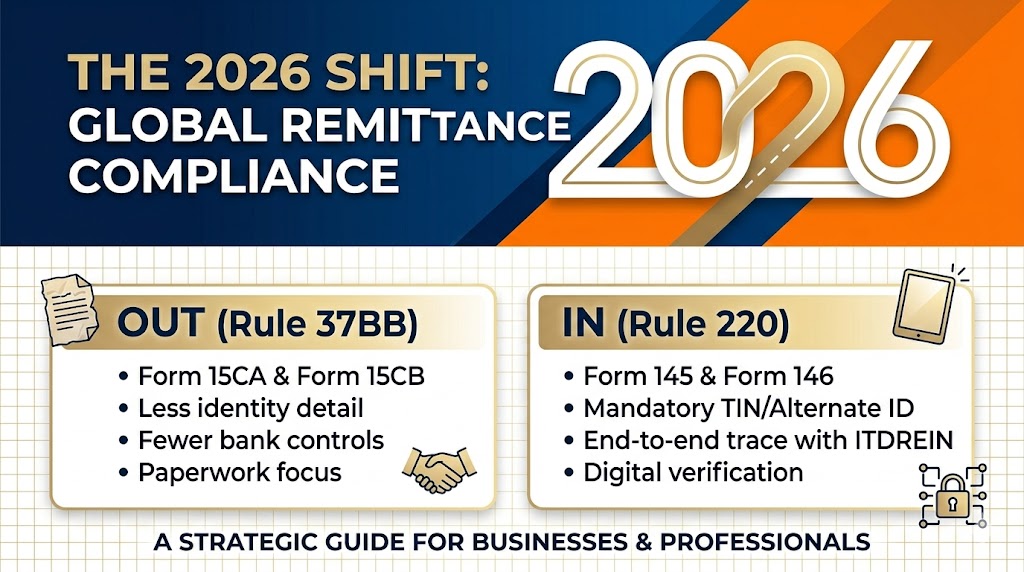
The Income-tax Rules, 2026 have introduced a completely revamped framework for reporting foreign remittances by replacing:
- Form 15CA / 15CB (Rule 37BB)
with - Form 145 / 146 (Rule 220)
This is not a mere procedural change—it represents a structural overhaul in reporting, documentation, and tax determination for cross-border payments.
1. Change in Legal Framework – Rule 37BB vs Rule 220
Under the new regime:
- Rule 220 governs furnishing of information for payments to non-residents
- It clearly categorizes compliance based on:
- Amount of remittance
- Taxability
- Nature of certification (AO / CA)
As per Rule 220: (Form 145 & 146)
- Part A: ≤ ₹5 lakh
- Part B: > ₹5 lakh with AO certificate
- Part C: > ₹5 lakh with CA certificate (CA Certificate in Form 146)
- Part D: Non-taxable remittances
While the broad classification of Parts (A to D) remains largely consistent with the earlier framework under Rule 37BB, the primary change lies in:
- Replacement of Form 15CA → Form 145
- Replacement of Form 15CB → Form 146
2. Significant Expansion in Remitter Details
Form 145/146 now requires comprehensive profiling of the remitter:
Newly Mandatory Fields:
- Residential Status (residential status as Resident, Non-resident, Resident but not ordinarily resident)
- Status (Individual, HUF, Company, Firm, AOP, etc.) - (Auto fatched from PAN)
- TAN (if available) - (Auto fatched from PAN)
- Email ID & Contact Number (Auto fatched from PAN)
These were not required in earlier Form 15CB, indicating a shift towards identity-based compliance tracking.
3. Strengthened Reporting for Remittee
The new rules significantly enhance global traceability.
Additional Requirements (Mandatory):
- Tax Identification Number (TIN) of country of residence
- Mandatory disclosure even via alternate unique ID if TIN unavailable
- Complete foreign address
- Email & contact details (If Available)
This aligns with international tax transparency standards.
4. Authorised Dealer & Banking Transparency
New disclosures include:
- Whether bank = authorised dealer
- If not, separate selection required
- Reporting of ITDREIN (Optional)
This ensures end-to-end traceability of remittance channels, which was missing earlier.
5. Explicit TDS Computation under the Act
A critical shift:
- Earlier (Form 15CB):
❌ No structured requirement to disclose tax rate under the Act (without DTAA) - Now:
✅ Mandatory reporting of:- Rate of TDS
This ensures that:
Tax under domestic law is determined first, before applying DTAA relief
6. Additional Details Required for DTAA Reporting
- In case of claiming DTAA benefit, it is mandatory to furnish:
- Tax Residency Certificate (TRC) Number
7. Pre-Filled Data & System Integration
The rules explicitly state:
- Certain fields will be auto-populated
This enhances:
- Accuracy
- Efficiency
- Reduced duplication
8. Form 146 (CA Certificate) – More Structured
Form 146 now requires:
- Separate section to report the UDIN (UDIN can be updated later)
9. Change in Verification Clause
There is a notable change in the verification/declaration section in Form 145/146 as compared to Form 15CA/15CB.
Key Enhancements:
- The verification is now more detailed and responsibility-driven
- It includes:
- Confirmation of correctness and completeness of information
- Acknowledgement of liability for short deduction or non-deduction of tax
- Acceptance of consequences including interest and penalties under the Act
This reflects a clear shift towards greater legal accountability of the remitter and certifying professional.
Conclusion
The transition from Form 15CA/15CB to Form 145/146 marks a fundamental shift in foreign remittance compliance.