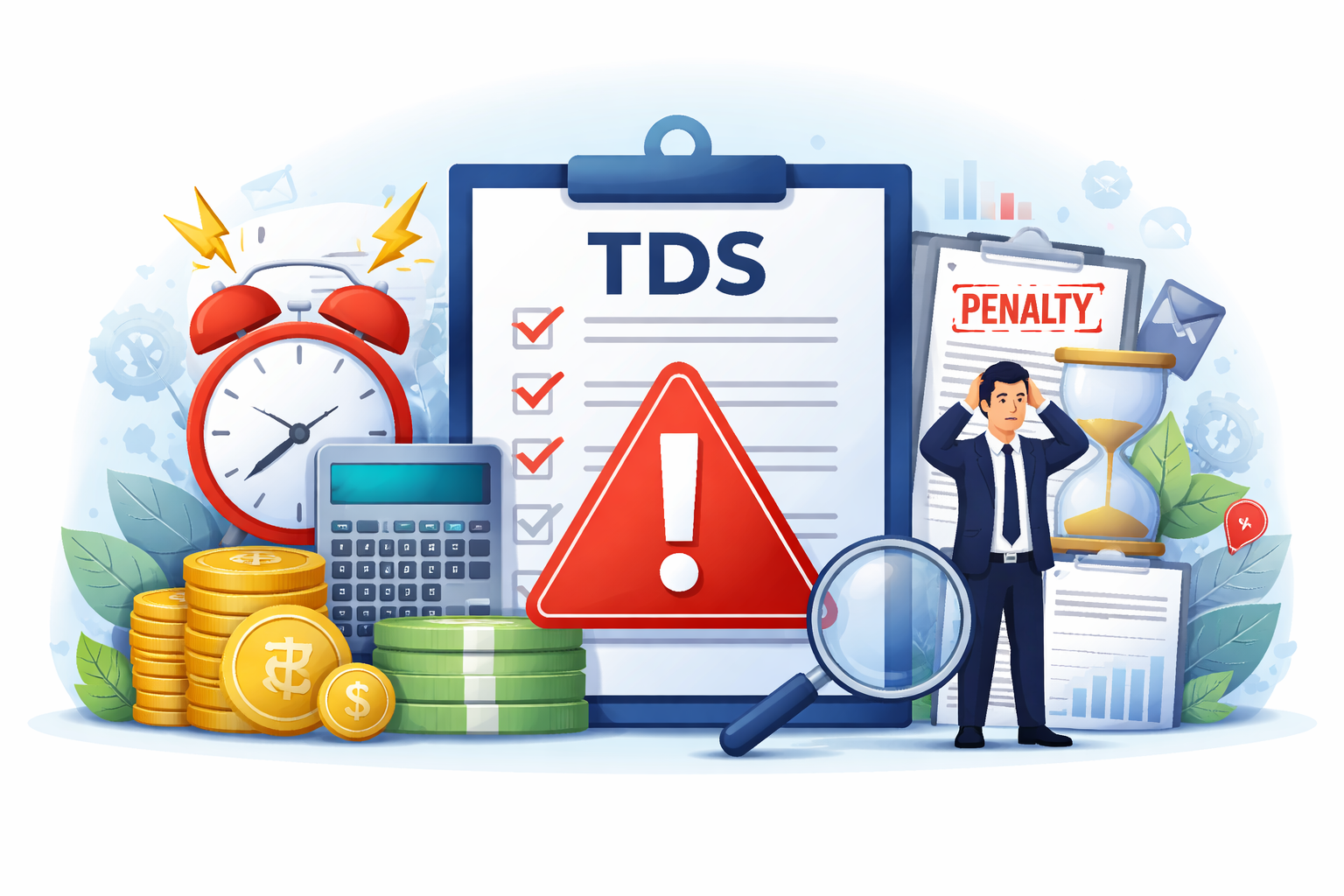
The Cost of a Tiny Oversight: A TDS Cautionary Tale
Imagine Arjun, a diligent entrepreneur running a thriving tech startup. Business was booming, and he had just moved into a sleek new office. To celebrate, he paid his interior decorator a final installment of ₹5,00,000. He knew about Tax Deducted at Source (TDS) compliance, so he dutifully withheld 10% and issued a cheque for the balance.
Six months later, Arjun received a notice from the Income Tax Department of India. To his horror, he was not just being asked for the tax amount, he was being hit with interest on late TDS deposit, a penalty for delayed TDS return filing and a disallowance of expense under the Income Tax Act. Because of a simple delay in depositing that withheld amount, Arjun’s ₹50,000 statutory deduction turned into a ₹2,00,000 compliance nightmare.
Arjun’s story is common. In the world of Indian taxation, TDS is often viewed as a “pass through” responsibility but the TDS compliance burden for businesses is heavy. Let’s explore the most common pitfalls and how you can shield your business from them.
Common TDS Mistakes That Could Cost You Dearly
1. Incorrect Rate of Deduction
Applying the wrong rate is perhaps the most frequent error. Rates vary significantly based on the nature of the payment and the status of the deductee (Individual v/s Company).
- The Trap: Deducting at 2% under Section 194C (Contractors) when the service actually falls under Section 194J (Professional Services) at 10%.
- The Solution: Maintain a "Tax Chart" updated with the latest Finance Act changes. When in doubt, classify based on the primary nature of the service.
2. Failure to Verify PAN (The 20% Penalty)
Under Section 206AA, if the person you are paying does not provide a valid PAN, you must deduct TDS at 20% (or the applicable rate, whichever is higher).
The Trap: Relying on a vendor’s promise to "send the PAN tomorrow."
The Solution: Never process a payment without a verified PAN on record.
3. Delays in Deposit and Filing
The government expects their cut by the 7th of the following month (except for March, which is April 30th).
The Trap: Thinking the deadline is for filing the return, not depositing the TDS.
The Solution: Set automated calendar reminders for the 5th of every month to ensure you have a two day buffer for bank processing.
The "Heavy Hitters": Key Sections to Remember
Understanding the specific sections helps in categorizing expenses correctly.
|
Section |
Nature of Payment |
Standard Rate |
|
192 |
Salaries |
Average Rate of Tax |
|
194C |
Payments to Contractors |
1% (Ind/HUF), 2% (Others) |
|
194J |
Professional/Technical Fees |
10% (2% for certain cases) |
|
194I |
Rent (Land/Building) |
10% |
|
194H |
Commission or Brokerage |
5% |
The Sting: Penalties and Interests
The Income Tax Department doesn't take kindly to "oops" moments. Here is what happens when things go wrong:
 A. Interest on Defaults (Section 201A)
- Non-Deduction: 1% per month or part of a month from the date on which tax was deductible to the date of actual deduction.
- Non-Payment: 1.5% per month or part of a month from the date of deduction to the date of actual payment.
Note: Even a one day delay counts as a full month for interest calculation.
B. Late Filing Fees (Section 234E)
If you fail to file your quarterly TDS return (Form 24Q, 26Q, etc.) by the deadline, you are liable to pay ₹200 per day for every day the failure continues. This fee is capped at the total amount of TDS.
C. The "Disallowance" Nightmare {Section 40(a)(ia)}
This is the hidden killer. If you fail to deduct or pay TDS on an expense, 30% of that entire expense is disallowed for tax purposes. This means you pay income tax on money you already spent!
How to Stay Compliant: A Proactive Checklist
To avoid becoming the next "Arjun," implement these three pillars of TDS management:
- Automate Your Accounting: Use software that automatically flags TDS thresholds. For instance, once a contractor’s total payments exceed ₹1,00,000 in a year, the system should force a deduction.
- Quarterly Reconciliation: Don't wait for the year end. Reconcile your books with your Form 26AS/AIS and the TRACES portal every quarter to spot mismatches early.
- Collect Form 15G/15H Early: If a payee claims they are below the taxable limit, ensure you have their valid 15G/15H form before making the payment. You cannot apply these retroactively.
Conclusion
TDS compliance is not just about paying taxes, it’s about safeguarding your business cash flow, audit health and legal standing. With structured documentation, timely deposits and disciplined monitoring, TDS can shift from a compliance risk to a routine process.
Remember: In the eyes of the Tax Man, “I forgot” is the most expensive sentence in the English language.